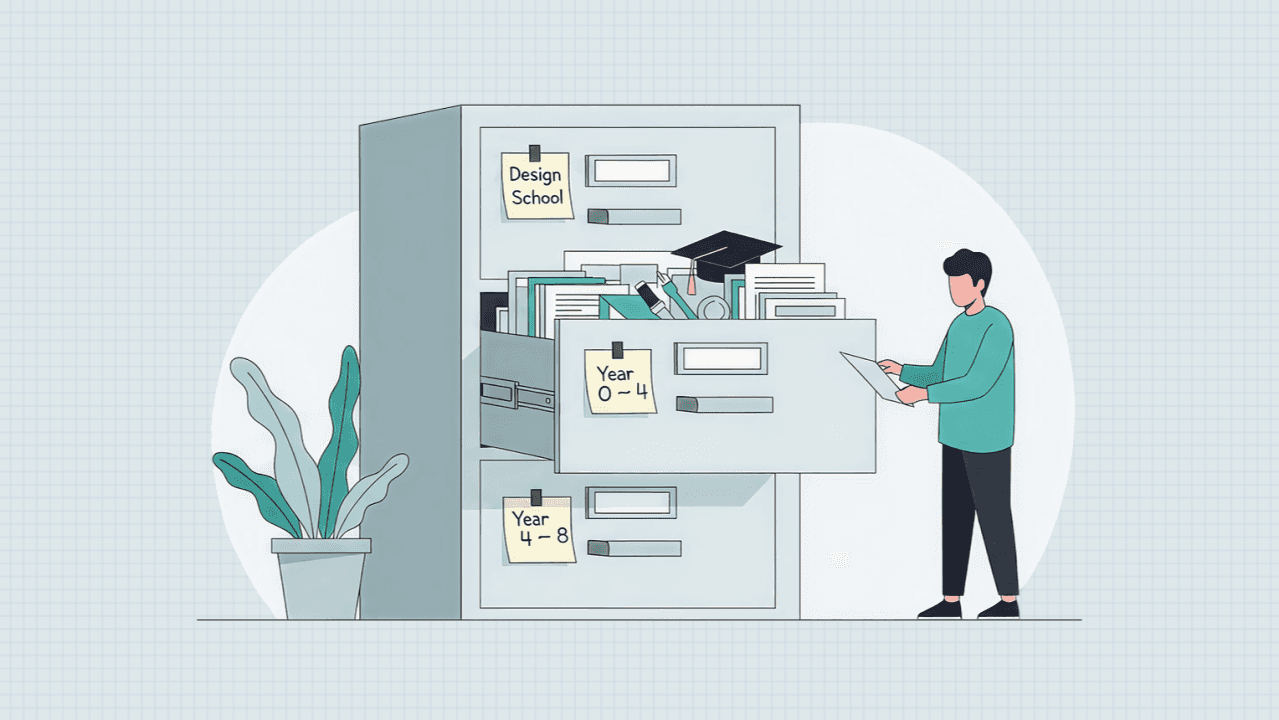
It’s been four years since I stepped out of design school and into the outside world. Back then, I wrote a short article looking back on a few of my learnings from college. I didn’t know then that I’d be back doing the same. This marks the second post in what I now see as a quadrennial series. A moment to pause, rewind, and articulate what I’ve learned every four years. ⭐️
Before we dive in, I’ll be honest- I didn’t plan this reflection as a neat list of insights. It’s just a kind of compilation of my thoughts across a few themes that have guided this ‘First Innings’ of my professional design journey…
1. Design is a Role, UX is a (shared) Responsibility.
When I started out, it used to slightly annoy me (or my ego) when a PM or a developer suggested a small tweak in the Design or a different interaction pattern because it would be better for our user. I used to think that I, as a designer, should be the one to care about the user. I am solely responsible for shaping the experience of the Product. (I mean that’s why I got the title of a ‘UX Designer’, right?)
But. I. Was. So. Wrong. 🤦🏻♂️
In most product organizations today, designers are often the flag bearers of ‘User-Experience’. But here's the thing, Good products are built when UX is a shared responsibility of everyone involved in building- Designers, Developers, QA, Product Managers, Marketers, etc.
Apart from hands-on design and craft, I have now started to realise that a significant part of your job as a product designer is to make your stakeholders care about UX. That’s what user advocacy looks like to me now. Because PMs shape intent. Developers shape execution. Designers shape perception. Marketers shape the story. Good UX needs everybody.
2. Nobody brags about B2B Enterprise Design. (But we probably should!?)
Designing consumer products is quite glamorous, right? Smooth onboarding flows, fun interactions, millions of users. Social Media is full of people talking about the design of their favourite quick-commerce app, food delivery app or e-commerce app.
But Enterprise SaaS Products are a different ball game altogether. They are Complex. They are Unique. Their context of use is different. These users don’t browse your product because they “want to”, they use them because they ‘have to’. Day in and day out, 5 days a week. Enterprise users don’t want all the fluff; they want focus. But that DOES NOT mean they don’t deserve beautifully crafted products!
In the past few years, I have grown a sense of satisfaction from designing beautiful & intuitive enterprise products. Products that break through complexity and talk-back to the users. 🏆
In my previous stint at Cashfree, I designed the Video KYC Agent and Auditor Portals. Despite the serious nature of these products, The Superior Product Experience that we co-built together, stood out and took the centre stage. Rich consumer-grade interactions and a few unique Interaction patterns, some of which set new benchmarks in the V-KYC Industry.
#MakeB2BDesignCoolAgain 😎
[ Snippets from the Agent Portal | Designed for Productivity & Delight ]
[ Auditor Portal | Card-based Interactions for the Customer Review Process ]
3. Ownership Mindset: Saying ‘No Thanks, I Got This’ Since Age 5
If I look back, the seeds of ownership were sown early. My parents still laugh about how, as a kid, I was obsessed with the word “Ekta” (which means alone in Marathi). Anytime someone tried to help me with something- be it tying my shoelace, brushing my teeth, solving a puzzle, my response was apparently instant and unwavering:
“Ekta.” (As in, No thanks. I’ll do it myself.), with a raised hand and a little index finger pointing upwards…☝🏼
At the time, it was probably just childhood stubbornness. But in hindsight, it was my first relationship with making decisions. Doing, trying, struggling, yet owning it. And strangely, that instinct never really left me. Which is probably why I’ve felt at home in startups.
Startups don’t come with detailed specs or layers of sign-off. You’re expected to move fast, make decisions, figure things out, and above all, own it. Not just the design file, but the outcome itself. Ownership isn’t just about autonomy. It’s about accountability. It’s knowing that when something breaks (or works), your fingerprints are on it. And I’ve come to realize, I love that part. I enjoy being close to the chaos, close to the context, close to the consequence of every decision that I make.
Maybe it all started with that one word- 'Ekta'. And maybe it still drives me every time I choose to step up, make a decision, and build with intent. 💭
4. Working at Startups: Ambiguity and Figureoutability
If there’s one environment that’s shaped me the most as a designer, it’s probably startups. The speed of execution is relentless, the clarity is mutually cultivated over time, and the brief is sometimes just a Slack thread. But that’s also exactly why I’ve loved it. 👀
One of the unusual skills that I learnt over the past few years is ‘Figureoutability’, (a made-up word, which means the ability to figure things out). One mantra that has helped me enhance this ability has been to “Start, then Learn. Don't Learn, then Start." Step 1 (a.k.a. starting) is the most difficult part of doing something new. Once you straight up dive head-first into it, you have already overcome this Step 1 without any hesitation. Now you have no option left but to navigate your way around by doing whatever it takes. This helps you learn & figure things out 10x faster than spending too much time to prep or learn the theory. 🚀
I’ve worked in teams where things moved fast. With speed comes ambiguity. This ambiguity can be paralyzing, but to me it has been liberating. In order to navigate this ambiguity, I learnt to ask better questions, and trust my instincts because in smaller teams there are often no solid structured processes to fall back on.
5. From AI to I: Choosing what I’ll keep to myself…
I think it was way back in around Jan/Feb 2023, when I got my hands on ChatGPT for the first time. It was surreal and felt out-of-this-world back then. Being awestruck by the kind of responses it generated, I couldn’t believe that AI was so much ‘out there’ and available at a consumer level, straight out of Andrew NG’s Machine Learning course. After playing around for a few days, I had written a small piece about an underrated skill that would help one thrive in the AI world.
Since then, there has been no looking back. I dived head-first into AI and prompted my way through to feed my curiosity. These explorations took me places. I crunched numbers for my blog, created images, created Video Ads, Built Products/Tools, all using just prompts. In many ways, AI also became a collaborator in my day-to-day design work. ✨
But through all of that, there is this one thing I’ve quietly chosen to keep only to myself- “Writing”. ✍🏼
Despite understanding that AI is obviously far better than me in writing and using language more effectively, I am quite adamant on not outsourcing writing as a skill, or as a mode of communication. Be it for my LinkedIn posts, blogs, formal/ informal messages, emails, etc. Because to me, 'Writing = Thinking'. And the sheer idea of outsourcing my ability to think, is straight-up unacceptable to me. At least as of today.
And No, don’t get me wrong. I’ve often used AI for little suggestions, cleanup, or nudges whenever I’m stuck. But when it comes to crafting a thought, tinkering with it, finding the right tone or rhythm- I’ve just always preferred to do it “ekta”, all by myself.
Maybe four years from now, I’ll feel differently. Maybe I’ll just ask AI to write the next reflection with me. But for now, I’m choosing to commit to it.
Only one way to find out. Let’s meet again in four more years and see what changed.
See you on the other side…🗓️✌🏼